
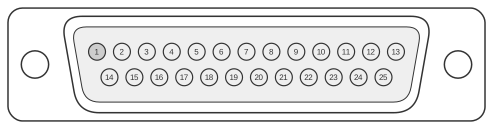
 25 PIN D-SUB MALE to the Amiga/Mac
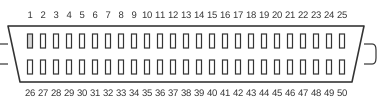 50 PIN HI-DENSITY D-SUB MALE to the peripheral
Apple Macintosh computers (and Amigas sharing the same convention) use a non-standard 25-pin D-Sub connector for their external SCSI port rather than the ANSI-specified 50-pin flat-ribbon or high-density connector. The DB-25 carries all 18 SCSI signals — eight data lines, one parity line, and nine control lines — along with Termination Power, with six of its pins (7, 9, 14, 16, 18, 24) serving as common ground returns. An adapter cable maps these to the industry-standard 50-pin high-density D-Sub (HD50, alternative 1 of the ANSI A cable) used on SCSI peripherals. The HD50 side follows the single-ended A-cable contact assignment defined in the SCSI-2 standard, with odd contacts 1–25 as ground and signals on even contacts 26–50.
| DSub | Hi DSub | |
|---|---|---|
| Request | 1 | 49 |
| Message | 2 | 46 |
| Input/Output | 3 | 50 |
| Reset | 4 | 45 |
| Acknowledge | 5 | 44 |
| Busy | 6 | 43 |
| Data Bus 0 | 8 | 26 |
| Data Bus 3 | 10 | 29 |
| Data Bus 5 | 11 | 31 |
| Data Bus 6 | 12 | 32 |
| Data Bus 7 | 13 | 33 |
| Control/Data | 15 | 48 |
| Attention | 17 | 41 |
| Select | 19 | 47 |
| Data Parity | 20 | 34 |
| Data Bus 1 | 21 | 27 |
| Data Bus 2 | 22 | 28 |
| Data Bus 4 | 23 | 30 |
| Termination Power | 25 | 38 |
Notes
- All the other pins (7, 9, 14, 16, 18, 24) at the DB-25 should be connected to the ground contacts (pins 1–25, odd) at the HD50 connector.
- All signals are active-low (asserted at low voltage, negated at high voltage) per the SCSI single-ended electrical convention.
- The HD50 connector uses 1.27 mm (0.05 in) pitch contacts; the DB-25 uses 2.77 mm pitch. The adapter is used only in single-ended (SE) mode; maximum cable length is 6.0 m for SE SCSI.
- On the Macintosh Plus, pin 25 (Termination Power) is not connected at the logic board end; all other Macintosh models supply +5 V on TERMPWR for terminator resistors only, not for powering SCSI peripherals.
- Data Bus 8–15 and the second parity bit (DBP1) are absent from both connectors; this adapter supports narrow (8-bit) SCSI only.
Signals
- Request (-REQ) — bus phase handshake signal driven by the target to request a data transfer byte from the initiator
- Message (-MSG) — control line asserted by the target during the Message bus phase
- Input/Output (-I/O) — control line indicating the direction of data transfer relative to the initiator (asserted = input to initiator)
- Reset (-RST) — resets all SCSI devices on the bus to their initial state
- Acknowledge (-ACK) — bus phase handshake signal driven by the initiator to acknowledge a REQ
- Busy (-BSY) — indicates the bus is in use; asserted by any device that has reserved the bus
- Data Bus 0–7 (-DB0–-DB7) — eight active-low data lines forming the narrow SCSI data byte
- Control/Data (-C/D) — distinguishes Control phase (asserted) from Data phase (negated) on the bus
- Attention (-ATN) — asserted by the initiator to request a Message Out phase from the target
- Select (-SEL) — used by the initiator to select a target device, or by the target during reselection
- Data Parity (-DBP) — odd parity bit covering Data Bus 0–7; asserted when the number of asserted data bits is even
- Termination Power (TERMPWR) — +5 V supply provided by the initiator through a blocking diode to power terminator resistor networks at each end of the cable