
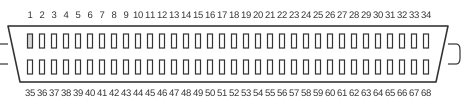
 Cable Pair Location
The 68-conductor wide SCSI cable — designated the P cable in SCSI Parallel Interface (SPI) standards and the B cable in the earlier SCSI-2 specification (ANSI X3.131-1994) — carries a 16-bit data bus (DB0–DB15) together with two parity lines (DBP, DBP1) and the full set of SCSI control signals. The high-density 68-pin (HD68) connector operates at 0.05 in (1.27 mm) pitch and is used on Wide, Ultra, Ultra2, Ultra160, and Ultra320 SCSI drives and host adapters. In single-ended (SE) mode the cable is limited to 6 m; high-voltage differential (HVD, RS-485) extends that to 25 m; low-voltage differential (LVD) introduced with Ultra2 permits up to 12 m. Pins 1–34 carry ground or power in SE mode, with signals occupying pins 35–68; the differential column repurposes the lower pins as positive-sense signal pairs.
| PIN | CABLE PAIR | SINGLE ENDED Signal Name | DIFFERENTIAL Signal Name |
|---|---|---|---|
| 1 | 30 | GROUND | +DB12 |
| 2 | 31 | GROUND | +DB13 |
| 3 | 32 | GROUND | +DB14 |
| 4 | 33 | GROUND | +DB15 |
| 5 | 34 | GROUND | +PARITY1 |
| 6 | 16 | GROUND | GROUND |
| 7 | 17 | GROUND | +DB0 |
| 8 | 18 | GROUND | +DB1 |
| 9 | 19 | GROUND | +DB2 |
| 10 | 20 | GROUND | +DB3 |
| 11 | 21 | GROUND | +DB4 |
| 12 | 22 | GROUND | +DB5 |
| 13 | 23 | GROUND | +DB6 |
| 14 | 24 | GROUND | +DB7 |
| 15 | 25 | GROUND | +PARITY |
| 16 | 15 | GROUND | DIFFSENSE |
| 17 | 14 | TERMPWR | TERMPWR |
| 18 | 13 | TERMPWR | TERMPWR |
| 19 | 12 | RESERVED | RESERVED |
| 20 | 5 | GROUND | +ATN |
| 21 | 6 | GROUND | GROUND |
| 22 | 7 | GROUND | +BSY |
| 23 | 4 | GROUND | +ACK |
| 24 | 3 | GROUND | +RST |
| 25 | 8 | GROUND | +MSG |
| 26 | 9 | GROUND | +SEL |
| 27 | 10 | GROUND | +C/D |
| 28 | 2 | GROUND | +REQ |
| 29 | 1 | GROUND | +I/O |
| 30 | 11 | GROUND | GROUND |
| 31 | 26 | GROUND | +DB8 |
| 32 | 27 | GROUND | +DB9 |
| 33 | 28 | GROUND | +DB10 |
| 34 | 29 | GROUND | +DB11 |
| 35 | 30 | -DB12 | -DB12 |
| 36 | 31 | -DB13 | -DB13 |
| 37 | 32 | -DB14 | -DB14 |
| 38 | 33 | -DB15 | -DB15 |
| 39 | 34 | -PARITY1 | -PARITY1 |
| 40 | 16 | -DB0 | GROUND |
| 41 | 17 | -DB1 | -DB0 |
| 42 | 18 | -DB2 | -DB1 |
| 43 | 19 | -DB3 | -DB2 |
| 44 | 20 | -DB4 | -DB3 |
| 45 | 21 | -DB5 | -DB4 |
| 46 | 22 | -DB6 | -DB5 |
| 47 | 23 | -DB7 | -DB6 |
| 48 | 24 | -PARITY | -DB7 |
| 49 | 25 | GROUND | -PARITY |
| 50 | 15 | GROUND | GROUND |
| 51 | 14 | TERMPWR | TERMPWR |
| 52 | 13 | TERMPWR | TERMPWR |
| 53 | 12 | RESERVED | RESERVED |
| 54 | 5 | GROUND | -ATN |
| 55 | 6 | -ATN | GROUND |
| 56 | 7 | GROUND | -BSY |
| 57 | 4 | -BSY | -ACK |
| 58 | 3 | -ACK | -RST |
| 59 | 8 | -RST | -MSG |
| 60 | 9 | -MSG | -SEL |
| 61 | 10 | -SEL | -C/D |
| 62 | 2 | -C/D | -REQ |
| 63 | 1 | -REQ | -I/O |
| 64 | 11 | -I/O | GROUND |
| 65 | 26 | -DB8 | -DB8 |
| 66 | 27 | -DB9 | -DB9 |
| 67 | 28 | -DB10 | -DB10 |
| 68 | 29 | -DB11 | -DB11 |
Notes
- The HD68 connector uses 0.05 in (1.27 mm) pitch contacts; the matching cable is a 68-conductor flat ribbon or 34 twisted-signal-pair construction. In the twisted-pair variant each signal conductor is paired with a dedicated ground return, which is the origin of the term “quiet cable”.
- Pins 17–18 and 51–52 carry TERMPWR (+5 V). SE termination uses 220 Ω to TERMPWR and 330 Ω to GND at each cable end; TERMPWR is supplied by the initiator through a blocking diode.
- Pin 16 carries DIFFSENSE (DIFFSNS) in differential mode. A differential SCSI device monitors this pin: if it is pulled to ground by an SE device on the bus, the HVD drivers are disabled to prevent damage. LVD devices use the same pin for the same protection function.
- In HVD mode the cable impedance is 122 Ω characteristic; in SE mode stub length must not exceed 0.1 m, and in HVD mode stubs must not exceed 0.2 m.
- Pin 19 and pin 53 are RESERVED and must not be grounded or driven by end devices.
- Wide SCSI adds the upper byte DB8–DB15 and a second parity bit DBP1 (labelled -PARITY1 in the SE column). Narrow (8-bit) SCSI devices ignore these signals.
Signals
- GROUND — signal return / shield; pins 1–16, 20–21, 30, 49–50 (SE mode lower pins) provide dedicated ground returns
- TERMPWR — terminator power rail (+5 V); supplied by the initiator through a blocking diode; used to bias SE terminators
- RESERVED — reserved contact; must not be connected
- DIFFSENSE — differential sense (pin 16); pulled low by SE devices to disable HVD drivers and prevent bus damage
- -DB0 – -DB7 — active-low data bus, lower byte (bits 0–7); asserted low = logic 1
- -DB8 – -DB15 — active-low data bus, upper byte (bits 8–15); wide SCSI extension
- -PARITY — active-low bus parity for lower data byte (DBP)
- -PARITY1 — active-low bus parity for upper data byte (DBP1); wide SCSI only
- -ATN — Attention; initiator signals target to enter Message Out phase
- -BSY — Busy; asserted by any device currently using the bus
- -ACK — Acknowledge; initiator handshake response to REQ during information transfer
- -RST — Reset; asserts a SCSI bus reset condition; all devices must go to BUS FREE
- -MSG — Message; target asserts during Message phase
- -SEL — Select; used during Selection and Reselection phases to address a target or initiator
- -C/D — Control/Data; distinguishes control (message/command/status) from data phases
- -REQ — Request; target handshake signal during information transfer
- -I/O — Input/Output; target indicates transfer direction relative to the initiator