
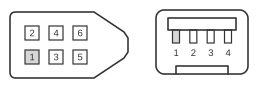
 4 pin, 6 pin or 9 pin IEEE1394 (FireWire) plug connectors at the cable.
IEEE 1394 — known as FireWire (Apple) and i.LINK (Sony) — is a high-speed serial bus for connecting peripherals such as digital camcorders, external drives and audio interfaces. Standardised as IEEE 1394 in 1995 and based on Apple’s FireWire design, it provides peer-to-peer, hot-pluggable connections in a daisy-chained or branched (tree) topology, and can operate without a host PC. Devices configure the bus automatically at power-up. Signalling runs over one or two shielded twisted pairs at 100, 200 or 400 Mbit/s (S100/S200/S400), with later revisions (FireWire 800 / IEEE 1394b) reaching 800 Mbit/s and beyond.
The connector exists in three forms: a 4-pin version (signal only, common on camcorders), a 6-pin version (adding bus power), and a 9-pin “FireWire 800” (1394b) version.
| 4-pin | 6-pin | 9-pin | Name | Description | Color |
|---|---|---|---|---|---|
| 1 | 8 | Power | Unregulated DC; 30 V no load | white | |
| 2 | 6 | Ground | Ground return for power and inner cable shield | black | |
| 1 | 3 | 1 | TPB- | Twisted-pair B, differential signals | orange |
| 2 | 4 | 2 | TPB+ | Twisted-pair B, differential signals | blue |
| 3 | 5 | 3 | TPA- | Twisted-pair A, differential signals | red |
| 4 | 6 | 4 | TPA+ | Twisted-pair A, differential signals | green |
| 5 | A shield | ||||
| 7 | - | ||||
| 9 | B shield | ||||
| Shell | Outer | cable shield |
Notes
- The 6-pin and 9-pin connectors carry bus power (roughly 8–30 V, up to about 1.5 A) to run the physical layer of attached devices; the 4-pin connector omits the power pair.
- Two crossed twisted pairs, TPA and TPB, carry the differential data and arbitration signalling.
- Up to 63 nodes can share one bus, with as many as 16 cable hops between them (standard cable up to 4.5 m per hop).