
The Macintosh Plus and all subsequent beige-era Macintosh computers equipped their modem and printer serial ports with an 8-pin mini-DIN connector driven by a Zilog Z8530 SCC (Serial Communications Controller) IC. The port uses RS-422 balanced-differential signalling rather than RS-232, with separate + and − wire pairs for transmit and receive data, allowing longer cable runs and higher data rates than single-ended RS-232. To connect such a Mac to a standard RS-232 modem (DB-25 DCE), an adapter cable must translate between the two electrical and mechanical interfaces. This variant routes the SCC’s HSKo handshake output to both RTS (pin 4) and DTR (pin 20) on the modem side, and uses the Mac’s GPIn general-purpose input (pin 7) to carry the modem’s DCD signal.
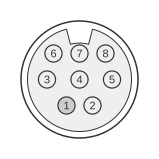 8 PIN MINI-DIN MALE to the Computer
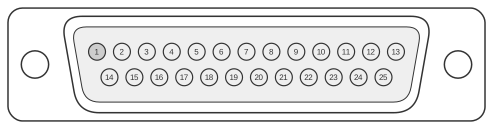 25 PIN D-SUB MALE to the Modem
| Mac | Dir | Modem | ||
|---|---|---|---|---|
| HSKo | 1 | OUT | 4+20 | RTS+DTR |
| HSKi | 2 | IN | 5 | CTS |
| TxD- | 3 | OUT | 2 | TxD |
| RxD- | 5 | IN | 3 | RxD |
| GND+RxD+ | 4+8 | - | 7 | GND |
| GPi | 7 | IN | 8 | DCD |
Signals
- HSKo — Handshake Out; driven by the Z8530 SCC DTR pin; wired to both RTS (pin 4) and DTR (pin 20) at the modem end in this cable variant.
- HSKi — Handshake In / external clock input; receives CTS from the modem.
- TxD− — Transmit Data, negative leg of the RS-422 balanced pair; connected to the modem’s single-ended RS-232 TxD line.
- RxD− — Receive Data, negative leg of the RS-422 balanced pair; connected to the modem’s RS-232 RxD line.
- GND+RxD+ — Mac pins 4 (Signal Ground) and 8 (RxD+, positive Receive Data leg) are both tied to modem pin 7 (Signal Ground), completing the RS-422 to RS-232 level conversion.
- GPi — General Purpose Input (GPIn); used here to receive the modem’s DCD (Data Carrier Detect) signal.
Notes
- The Mac serial port is RS-422 balanced-differential; it is not electrically compatible with RS-232 without an adapter. This cable performs a passive level conversion suitable for short cable runs; for longer distances an active RS-422-to-RS-232 converter is recommended.
- The modem-side connector is a DB-25 male, as used on RS-232 DCE (modem) equipment per TIA/EIA-232-F.
- Mac pins 4 and 8 being tied together to modem GND collapses the differential pair on the receive side; this is the standard approach for low-speed modem connections.
- A companion cable variant (without DTR) routes HSKo only to RTS, and loops DSR and DTR at the modem end instead.
References
- Guide to the Macintosh Family Hardware, Second Edition — Apple Computer Inc. / Addison-Wesley, 1990