
An RS-232 to RS-422 converter cable translates the single-ended, unbalanced signals of a PC serial port (TIA/EIA-232-F) into the balanced differential signalling defined by TIA/EIA-422-B (ITU V.11/X.27). RS-422 supports one driver per bus driving up to ten receivers, operates at data rates up to 10 Mbit/s, and extends cable runs to approximately 1,200 m — far beyond the ~15 m practical limit of RS-232. The converter typically contains a transceiver IC such as the TI SN75176B, which converts the RS-232 TxD line to a differential pair (TxD+/TxD−) and a separate receive pair (RxD+/RxD−) for full-duplex operation; the RS-232 RTS line may control the driver-enable pin for half-duplex RS-422 variants. Electrically isolated versions include optical or transformer isolation to break ground loops between equipment.
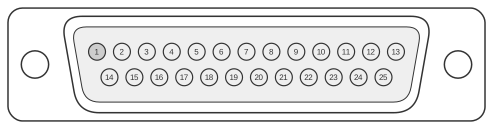 25 pin D-SUB male connector
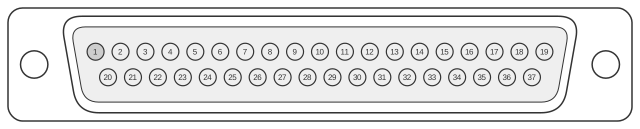 37 pin D-SUB male connector
Notes
- The RS-422 side uses two twisted pairs: one transmit pair (TxD+/TxD−) and one receive pair (RxD+/RxD−), providing full-duplex communication.
- The 37-pin D-sub connector (EIA-449/RS-449) was the original RS-422 connector; modern adapters commonly use a 9-pin D-sub on the RS-422 side.
- RS-422 receiver input sensitivity is ±200 mV, giving high immunity to common-mode noise compared with RS-232’s ±3 V threshold.
- Terminate the RS-422 twisted-pair cable with a 120 Ω resistor at each end, matched to the cable’s characteristic impedance, to prevent signal reflections at high data rates.
- RS-232 driver output is ±5 V to ±15 V; RS-422 differential driver output is ±2 V to ±6 V — the converter IC handles the level translation.