
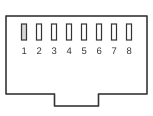
 8 pin RJ45 (8P8C) female connector at the interface card.
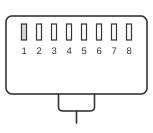 8 pin RJ45 (8P8C) male connector at the cable.
Token Ring is a local-area network technology developed by IBM and standardised as IEEE 802.5. Stations pass a small frame called a token around a logical ring to take turns transmitting, which avoids the collisions of early Ethernet; physically the network is wired as a star through a Multistation Access Unit (MAU/MSAU). It ran at 4 and 16 Mbit/s (with a later 100 Mbit/s version) and was largely displaced by Ethernet during the late 1990s. The original IBM cabling used the hermaphroditic IBM Data Connector with shielded twisted pair; the RJ-45 (8P8C) pinout below is the alternative used to run Token Ring over unshielded twisted pair, in place of the DB-9 connector.
| Pin | Name | Direction | Description |
|---|---|---|---|
| 1 | NC | Not Connected | |
| 2 | NC | Not Connected | |
| 3 | Tx+ | OUT | Transmit Data |
| 4 | Rx- | IN | Receive Data |
| 5 | Rx+ | IN | Receive Data |
| 6 | Tx- | OUT | Transmit Data |
| 7 | NC | Not Connected | |
| 8 | NC | Not Connected |
Notes
- The active pairs are pins 3 & 6 (transmit) and pins 4 & 5 (receive); pins 1, 2, 7 and 8 are unused.