
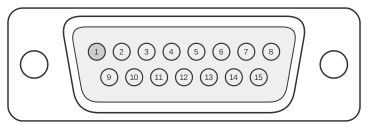
 15 pin D-SUB male connector at the Apple card cable, looking into cable-side connector.
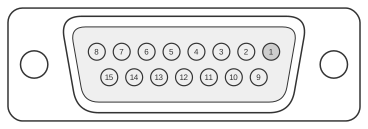 15 pin D-SUB female connector at the Apple computer.
The Apple EtherTalk Interface Card and EtherTalk NB Card expose a DA-15 male connector that implements the IEEE 802.3 Attachment Unit Interface (AUI), defined in Section 7 of the 1985 and 1990 revisions of that standard. The port carries the four standard differential signal pairs — Data Out (Transmit), Data In (Receive), Collision Presence, and Power — at 10 Mbit/s over thick coaxial cable via an external transceiver (Medium Attachment Unit). Apple’s signal naming uses “Collision presence” for what IEEE 802.3 labels Control Out; the electrical interface is otherwise identical to any standard AUI DA-15 port. The signals on this DA-15 port are not compatible with the DA-15 video connectors found on the Apple IIc, IIe, IIGS, or Apple III.
| Pin | Signal | Description |
|---|---|---|
| 1 | Shield | |
| 2 | Collision presence + | |
| 3 | Transmit + | |
| 4 | Reserved | |
| 5 | Receive + | |
| 6 | Power return | |
| 7 | Reserved | |
| 8 | Reserved | |
| 9 | Collision presence - | |
| 10 | Transmit - | |
| 11 | Reserved | |
| 12 | Receive - | |
| 13 | Power | |
| 14 | Reserved | |
| 15 | Reserved |
Signals
- Shield — chassis/cable shield; Pin 1 is the cable shield return.
- Collision presence +/- — differential pair (Pins 2 and 9); equivalent to the Control Out (CO-A/CO-B) pair in IEEE 802.3 AUI terminology, carries collision-presence signals from the transceiver to the card.
- Transmit +/- — differential Data Out pair (Pins 3 and 10); Manchester-encoded transmit data from the card to the transceiver.
- Receive +/- — differential Data In pair (Pins 5 and 12); Manchester-encoded receive data from the transceiver to the card.
- Power — 12 V supply to the external transceiver (Pin 13); Power return on Pin 6.
- Reserved — Pins 4, 7, 8, 11, 14, and 15; not used by Apple EtherTalk cards.
Notes
- The DA-15 connector on EtherTalk cards is a standard IEEE 802.3 AUI port and will work with any compatible thick-Ethernet (10BASE5) transceiver.
- An external transceiver is required; Apple did not supply one with the card.
- Do not confuse this port with the DA-15 video connector used on the Apple IIc, IIe, IIGS, and Apple III — the signals are entirely different and the connectors are mechanically interchangeable, risking damage.
- The AUI cable between card and transceiver must not exceed 50 metres; 77-ohm termination is required at each end of the AUI cable segment.
- The later Apple AAUI connector (introduced 1991) uses a proprietary 14-pin ribbon contact and is not mechanically compatible with this DA-15 AUI port, although the electrical signals are equivalent.
References
- Apple Peripheral Interface Guide (Service Technical Procedures), PN 072-0213F, Seventh Edition (January 1991)
- Cabling Specifications — Cisco MGS/AGS Hardware Reference, Appendix A
- IEEE 802.3-1990: IEEE Standards for Local Area Networks — CSMA/CD Access Method and Physical Layer Specifications, IEEE Standards Association