
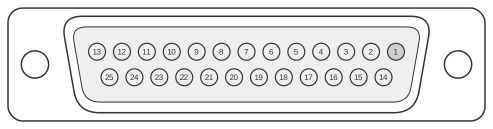
 25 pin D-SUB female connector
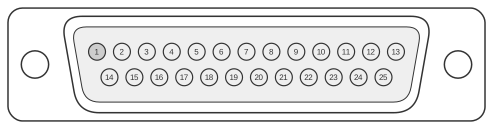 25 pin D-SUB male connector
The Apple LaserWriter carried two distinct serial interfaces: an RS-422 port (DB-9 on earlier models, DIN-8 on later ones) for AppleTalk/LocalTalk network connection, and a separate RS-232C port on a 25-pin D-sub (DB-25) connector for direct point-to-point connection from non-Apple hosts such as IBM-compatible PCs. A mode switch on the printer selects which interface is active. The RS-232C port implements a conventional subset of EIA-232 signals, with directions given relative to the printer. Pin assignments are documented in Apple’s 1988 LaserWriter Reference and the Apple Service Peripheral Interface Guide (1991).
| Pin | Name | Dir | Description |
|---|---|---|---|
| 1 | GND | - | Ground |
| 2 | TXD- | OUT | Transmit Data |
| 3 | RXD- | IN | Receive Data |
| 4 | RTS | OUT | Request To Send |
| 5 | CTS | IN | Clear To Send |
| 6 | DSR | IN | Data Set Ready |
| 7 | GND | - | Ground |
| 8 | DCD | OUT | Data Carrier Detect |
| 20 | DTR- | OUT | Data Terminal Ready |
| 22 | RING | IN | ? |
Notes
- Direction is Printer relative Computer.
- The DB-25 RS-232C port is a point-to-point serial interface for non-Apple hosts; it is mutually exclusive with the AppleTalk (RS-422) port — a mode switch on the printer selects which interface is active.
- The LaserWriter also carries an RS-422 serial port (DB-9 connector on original models) for AppleTalk/LocalTalk network connection; that port is not documented on this page.
- The Apple LaserWriter Reference (1988) documents cable configuration for IBM-compatible PC to LaserWriter RS-232C connections.
Signals
- GND — Signal ground (pins 1 and 7); reference for all signals on this connector.
- TXD- — Transmit Data; serial data output from the printer to the host.
- RXD- — Receive Data; serial data input to the printer from the host.
- RTS — Request To Send; flow-control output asserted by the printer when it is ready to transmit.
- CTS — Clear To Send; flow-control input from the host, permitting the printer to send.
- DSR — Data Set Ready; input indicating the host is ready.
- DCD — Data Carrier Detect; output from the printer.
- DTR- — Data Terminal Ready; output asserted by the printer to indicate it is powered and operational.
- RING — Ring Indicator.