
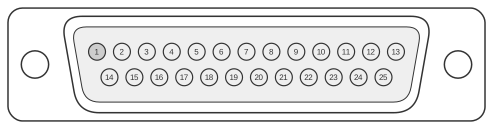
 25 PIN D-SUB MALE to the Computer
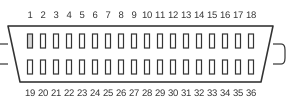 36 PIN CENTRONICS MALE to the Printer.
The Centronics parallel interface was developed by Centronics Data Computer Corporation (Hudson, NH) in the early 1970s and first appeared on the Model 101 dot-matrix printer. It transfers an 8-bit data byte over TTL-level lines using an active-low /STROBE handshake, with the printer acknowledging each byte via a 4 µs /ACKNOWLEDGE pulse and asserting BUSY while occupied. The peripheral-side connector is a 36-pin Amphenol micro-ribbon fitting, whilst the host (PC) side uses a standard 25-pin D-sub; IEEE 1284-1994 formalised this cable pairing as the 1284-A (D-sub, host) to 1284-B (micro-ribbon, printer) configuration, also introducing Nibble, Byte, EPP, and ECP bidirectional modes whilst preserving full backward compatibility with the original unidirectional Compatibility Mode.
| 25-DSub | 36-Cen |
|---|---|
| Strobe | 1 |
| Data Bit 0 | 2 |
| Data Bit 1 | 3 |
| Data Bit 2 | 4 |
| Data Bit 3 | 5 |
| Data Bit 4 | 6 |
| Data Bit 5 | 7 |
| Data Bit 6 | 8 |
| Data Bit 7 | 9 |
| Acknowledge | 10 |
| Busy | 11 |
| Paper Out | 12 |
| Select | 13 |
| Autofeed | 14 |
| Error | 15 |
| Reset | 16 |
| Select | 17 |
| Signal Ground | 18 |
| Signal Ground | 19 |
| Signal Ground | 20 |
| Signal Ground | 21 |
| Signal Ground | 22 |
| Signal Ground | 23 |
| Signal Ground | 24 |
| Signal Ground | 25 |
| Shield | Shield |
Signals
- Strobe (/STROBE) — active-low pulse from host; latches the data byte into the printer. Maximum interval between strobes is 500 µs; terminated with 470 Ω to +5 V on the printer side.
- Data Bit 0–7 — 8-bit parallel data bus (DATA 1–DATA 8 in Centronics notation); TTL levels, each line terminated with a 1 kΩ pull-up to +5 V on the printer. Data Bit 7 (DATA 8) was optional on the 101AL model.
- Acknowledge (/ACK, /ACKNOWLEDGE) — active-low output from printer; a 4 µs pulse indicating the byte has been received and the printer is ready for the next character.
- Busy — high output from printer while the printer is processing, moving paper, or otherwise unable to accept data.
- Paper Out (PAPER END / PE) — high when the printer has run out of paper.
- Select (SLCT) — high when the printer is online and selected.
- Autofeed (AUTO FEED) — when asserted by the host, instructs the printer to automatically advance one line after printing a carriage return.
- Error (/FAULT) — active-low output from printer indicating a fault condition.
- Reset (INPUT PRIME / /INIT) — active-low input; remotely resets the printer to its power-on state.
- Signal Ground — return paths for the data and handshake lines; multiple ground pins reduce noise on the parallel bus.
- Shield — chassis/cable shield connected at both ends.
Notes
The 36-pin peripheral-side connector is the Amphenol 57-30360 micro-ribbon, commonly called the “Centronics connector” or “Champ” connector; IEEE 1284 designates it the 1284-B connector. The host-side 25-pin D-sub is the 1284-A connector. A third type, the 1284-C (36-pin mini, 0.050″ pitch), was defined by IEEE 1284 for more compact devices but was rarely used in practice.
Compatibility Mode (SPP — Standard Parallel Port) is the original Centronics handshake operating in the forward-only direction at up to approximately 150 KB/s. IEEE 1284 extended this with four additional modes: Nibble (reverse channel, no extra hardware), Byte (full reverse byte using host hardware), EPP (Enhanced Parallel Port, up to ~2 MB/s, suited for non-printer peripherals), and ECP (Extended Capability Port, up to ~4 MB/s, with RLE compression and DMA support).
All data and handshake lines are TTL-compatible. Data lines are terminated with 1 kΩ pull-ups to +5 V; the /STROBE and INPUT PRIME lines use 470 Ω pull-ups. The cable must be kept short (IEEE 1284 specifies a maximum of 10 m, though 2 m is recommended for reliable SPP operation).
The Centronics connector was chosen because Wang Laboratories had surplus stock of 36-pin Amphenol micro-ribbon connectors originally used for a Wang calculator; only 21 of the 36 pins were required, and the remainder were used for ground returns or left unconnected.