
A three-wire serial cable is all that is required to connect virtually any consumer GPS receiver to a PC or Macintosh serial port. GPS receivers conforming to NMEA 0183 transmit position, speed, and time data as printable ASCII sentences at 4800 baud (8N1) over an RS-232-compatible serial link. The PC side uses a TIA/EIA-232-F (RS-232) interface on either a DB-9 (EIA-574) or DB-25 connector, while older Macintosh computers use an RS-422 mini-DIN-8 serial port (introduced with the Macintosh Plus in 1986) operated in single-ended mode for compatibility with RS-232 GPS receivers. Only three signals are needed: GPS Data Out (TxD) crosses to the host Receive Data pin, GPS Data In (RxD) crosses to the host Transmit Data pin, and a common Signal Ground completes the circuit.
 PC 9 PIN D-SUB FEMALE (on cable)
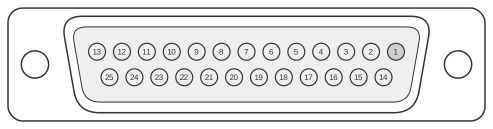 PC 25 PIN D-SUB FEMALE (on cable)
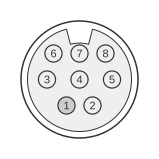 MAC MINI-DIN 8 MALE (on cable)
| GPS Signal name | PC or MAC signal name | PC DB9 | PC DB25 | MAC MINI-DIN 8 |
|---|---|---|---|---|
| Data OUT (TxD) | Receive Data (RxD) | 2 | 3 | 5 |
| DATA IN (RxD) | Transmit Data (TxD) | 3 | 2 | 3 |
| Signal Ground (SG) | Ground | 5 | 7 | 4 |
Signals
- Data OUT (TxD) — NMEA 0183 serial data transmitted from the GPS receiver to the host; connects to host RxD.
- DATA IN (RxD) — Serial data received by the GPS from the host (used for configuration commands); connects to host TxD.
- Signal Ground (SG) — Common ground reference shared by both data lines.
Notes
The cable wiring is a straight crossover on the data lines: GPS TxD to host RxD, GPS RxD to host TxD. No hardware handshake lines (RTS, CTS, DTR, DSR) are required for standard NMEA 0183 data transfer; the connection is effectively a three-wire null-modem link.
On the PC side, the DB-9 female connector (EIA-574) is standard on ATX-era desktop and laptop computers; DB-25 appears on older PCs and some serial expansion cards. Both follow TIA/EIA-232-F signal levels (±3 V to ±15 V logic swing). NMEA 0183 at 4800 baud is well within the 20 kbps maximum data rate of TIA/EIA-232-F.
The Macintosh mini-DIN-8 port is electrically RS-422 (balanced differential via Zilog 8530 SCC), but RS-232-compatible GPS receivers connect using only the minus (−) data wires — pin 5 (RxD−) and pin 3 (TxD−) — plus pin 4 (Signal Ground). The plus (+) wires (pins 6 and 8) are left unconnected. This single-ended usage was the standard practice for RS-232-to-Mac adapters of the era.
NMEA 0183 version 4.30 (December 2023) is the current release; most consumer GPS hardware implements version 2.x or 3.x sentences (GPRMC, GPGGA, GPGSA, GPGSV, GPVTG, GPGLL) which are compatible with all versions. NMEA 0183-HS operates at 38.4 kbaud on the same logical protocol when higher update rates are required.
References
- NMEA 0183 Standard — National Marine Electronics Association
- Garmin GPS 18x Series Technical Specifications (190-00879-08, Rev B)
- Interface Circuits for TIA/EIA-232-F — Texas Instruments, Application Note SLLA037A (via Internet Archive)
- Guide to the Macintosh Family Hardware, Second Edition — Apple Computer / Addison-Wesley, 1990 (ISBN 0-201-52405-8); archived at Internet Archive